In an era where rapid code deployment and continuous integration are paramount, Integrate GitLab Project with Microsoft Teams creates a central hub for notifications, discussions, and real-time updates. Our goal is to combine the robust development capabilities of GitLab with the collaborative environment of Teams, empowering teams to react swiftly to changes and maintain complete oversight of project developments.
Key benefits of integration include:
- Custom Notifications: Tailor alerts to specific events, ensuring only critical information reaches your team.
- Streamlined Communication: Instant notifications keep the team informed of commits, merges, and issues.
- Improved Efficiency: Reducing context-switching by centralizing updates within Teams.
- Enhanced Collaboration: Allowing team members to quickly discuss and resolve issues directly from the Teams channel.
Prerequisites for a Successful Integration
Before diving into the configuration process, ensure you have met the following prerequisites:
- GitLab Account and Repository: An active GitLab account with at least one project you wish to monitor.
- Microsoft Teams Account: Access to Microsoft Teams with permission to add connectors to channels.
- Administrative Rights: Ensure you have the required administrative privileges to configure webhooks in GitLab and set up connectors in Teams.
- Basic Knowledge of Webhooks: Familiarity with the concept of webhooks will simplify the integration process.
Meeting these prerequisites will ensure that how to Integrate GitLab Project with Microsoft Teams and that you can troubleshoot any issues with minimal disruption.
Configuring the Microsoft Teams Connector
You can integrate Microsoft Teams notifications with GitLab and display notifications about GitLab projects in Microsoft Teams. To integrate the services, you need to follow the steps outlined below:
Step 1: Add an Incoming Webhook to Your Teams Channel
To set up a webhook in Microsoft Teams, you need to do the following:
- Open Microsoft Teams and go to the channel where you want to receive notifications.
- Click on the three-dot “…” icon next to the channel name and select Connectors.
- Search for “Incoming Webhooks” and click the “Add” button.

Configure Webhook: Click on Configure, then give your webhook a name that reflects its purpose (e.g., “GitLab Notifications”). You can also upload an icon that represents your GitLab project.

Generate URL: After configuration, Teams will generate a unique URL for the webhook. Copy this URL as it is crucial for the next step.

Setting Up the GitLab Webhook
Once the Microsoft Teams connector is configured, the next step is to set up the corresponding webhook in GitLab.
Step 1: Navigate to Your GitLab Project Settings
- Access Your Project: Log into your GitLab account and select the project you wish to integrate.
- Project Settings: In the sidebar, click on Settings and then select Integrations (or Webhooks in some versions).
Step 2: Add a New Webhook
- In the Integrations page, click on Microsoft Teams.
- Paste the webhook URL you obtained in Step 1 into the Webhook URL field.
- Choose the events you want to trigger the webhook. For example, you might want to receive notifications when a new issue is created or when a merge request is approved.
- Click on Add webhook to save your changes.
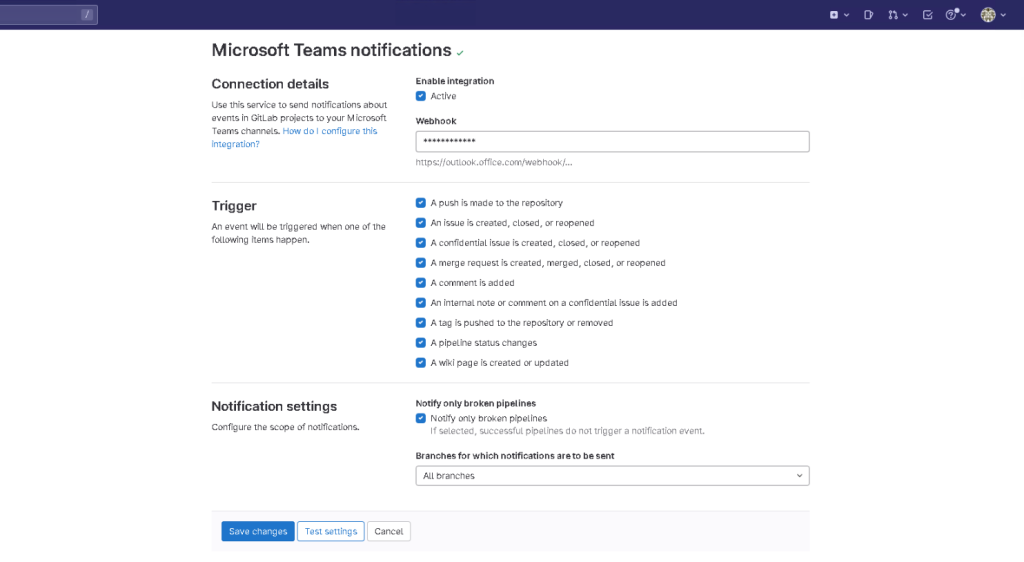
Step 3: Test the Webhook
To test the integration between GitLab and Microsoft Teams, you can do the following:
- Go to your GitLab project and create a new issue or merge request.
- Wait for a few seconds and check your Microsoft Teams channel for the notification.
If you receive the notification, then the integration is working correctly. If you do not receive the notification, you can check the webhook URL and make sure that it is correct.
Step 4: Troubleshoot common issues
If you are experiencing issues with the GitLab-Microsoft Teams integration, you can try the following troubleshooting steps:
- Make sure that the webhook URL is correct and active.
- Check the events you have selected in the webhook configuration. You may need to add more events or remove unnecessary ones.
- Check the notification settings in GitLab to make sure that notifications are enabled for the events you want to trigger the webhook.
- Check the notification settings in Microsoft Teams to make sure that the GitLab app is allowed to send notifications to your channel.
- Check the GitLab logs to see if there are any error messages that might indicate the problem.
By following these steps, you should be able to configure your GitLab project to push notifications to the Microsoft Teams webhook successfully. Remember to test the integration and troubleshoot any issues that you may encounter. With GitLab-Microsoft Teams integration, you can stay up-to-date with your GitLab project and collaborate more efficiently with your team.
Now, you should see your GitLab project integrated into your Microsoft Teams channel. You can receive notifications about new commits, merge requests, and other GitLab events right in your Microsoft Teams channel. Additionally, you can also use GitLab commands within the Teams channel to perform various GitLab operations, such as creating merge requests or viewing issues.
Real-World Use Cases and Benefits
Integrating GitLab with Microsoft Teams using the connector opens up a plethora of opportunities for teams across various industries. Here are some real-world examples of how this integration can be beneficial:
Accelerating Development Cycles
By receiving real-time notifications about commits, merges, and pipeline statuses, development teams can rapidly identify issues and address them before they escalate. This integration ensures that every team member is aware of the project’s current status, reducing delays and improving overall productivity.
Enhancing Cross-Functional Collaboration
When developers, QA engineers, and project managers are all part of the same Teams channel receiving updates, cross-functional communication improves. This fosters a more collaborative environment where all stakeholders are aligned on project goals and timelines.
Improving Incident Response
In scenarios where a build fails or an unexpected error occurs, immediate notifications enable the team to react promptly. This swift response mechanism can be crucial in minimizing downtime and ensuring that issues are resolved quickly.
Streamlined Code Reviews
By integrating GitLab notifications into Teams, code review processes become more streamlined. Team members can instantly discuss and review code changes, leading to faster approvals and higher quality code.
Finally, we explained step by step how to Integrate GitLab Project with Microsoft Teams using the connector is a powerful strategy to enhance team collaboration and streamline development workflows. By following the detailed steps outlined in this guide, we ensure that your team stays informed, proactive, and aligned throughout the development lifecycle. Our approach not only focuses on seamless notifications but also emphasizes security, customization, and real-world application, ensuring that every team member benefits from this integration.



![How to Set Up Mail Forwarding in Procmail on Ubuntu? [Step-by-Step Guide]](https://a2zeducate.com/wp-content/uploads/2025/03/Procmail-on-Ubuntu-1-150x150.png)




![How To Create Facebook App ID to Configure in Yoast or Rank Math SEO Tools? [Step-by-Step Guide]](https://a2zeducate.com/wp-content/uploads/2023/05/Article-title-150x150.png)